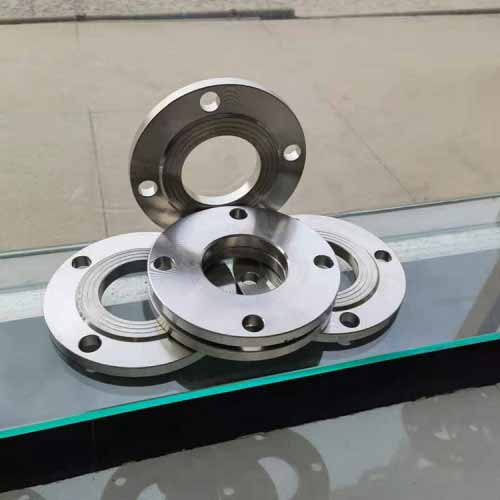
Product details description
In piping systems, a flange is the connector that joins pipes to valves,
pumps, or walls. Precision in dimensions and tolerances is not just a quality
metric; it is a safety requirement to prevent leaks and catastrophic failures
under pressure.
Key Standards
The two dominant standards are ASME B16.5 (US/Imperial) and EN 1092-1
(European/Metric). A "Class 150" flange in B16.5 is not interchangeable with a
"PN10" flange in EN standards, even if the pipe size matches.
Critical Dimensions
Bolt Circle Diameter (BCD): The circle formed by the center of the bolt
holes. If this is off by even 1mm, bolts won't line up, causing uneven gasket
compression and leaks.
Number of Holes: Must match the mating flange exactly.
Bore Size: The inner diameter must match the pipe's outer diameter (OD) to
ensure smooth flow (full bore) or specific flow rates (reduced bore).
Raised Face (RF): The height of the sealing surface. Standard RF is 1/16"
(1.6mm). Ring Joint (RTJ) flanges have grooves for metal gaskets.
Tolerance Classes
Diameter Tolerance: For a 12-inch flange, the tolerance is usually ±0.25mm
to ±0.5mm.
Squareness: The flange face must be perfectly 90 degrees to the bore. If
tilted, the gasket won't seal evenly when the bolts are tightened.
Surface Finish: The sealing face usually requires a roughness average (Ra)
of 125μin to 250μin. Too smooth, and the gasket slips; too rough, and it cuts
into the gasket.
Previous article:
High-Pressure Orifice Flanges - Rated for Demanding Applications
Next article:
5 Key Considerations for Flange Installation: Alignment, Torque, and Leak Prevention